Even under severe exclusion from public life, Afghan women continue to organize and lead. This reality framed the high-level event “What Leadership Do We Need for the Future?”, during which the Women’s Jirga for Afghanistan (WJA) was launched on March 8, 2026, on the margins of the Commission on the Status of Women in New York.
The initiative was presented as a women-led global process designed to place Afghan women’s lived realities, priorities, and policy demands at the center of international engagement on Afghanistan. Nearly five years after the Taliban’s takeover, speakers underscored that over one hundred edicts restrict women’s access to education, work, mobility, and public life. Recalling Afghanistan’s democratic past, Steering Committee member Fatima Gailani said: “I remember an Afghanistan where men and women received the right to vote on the same day. This is the Afghanistan we must reclaim.” The initiative underscores Afghan women not only as rights-holders, but as solution-builders shaping pathways for Afghanistan’s future.
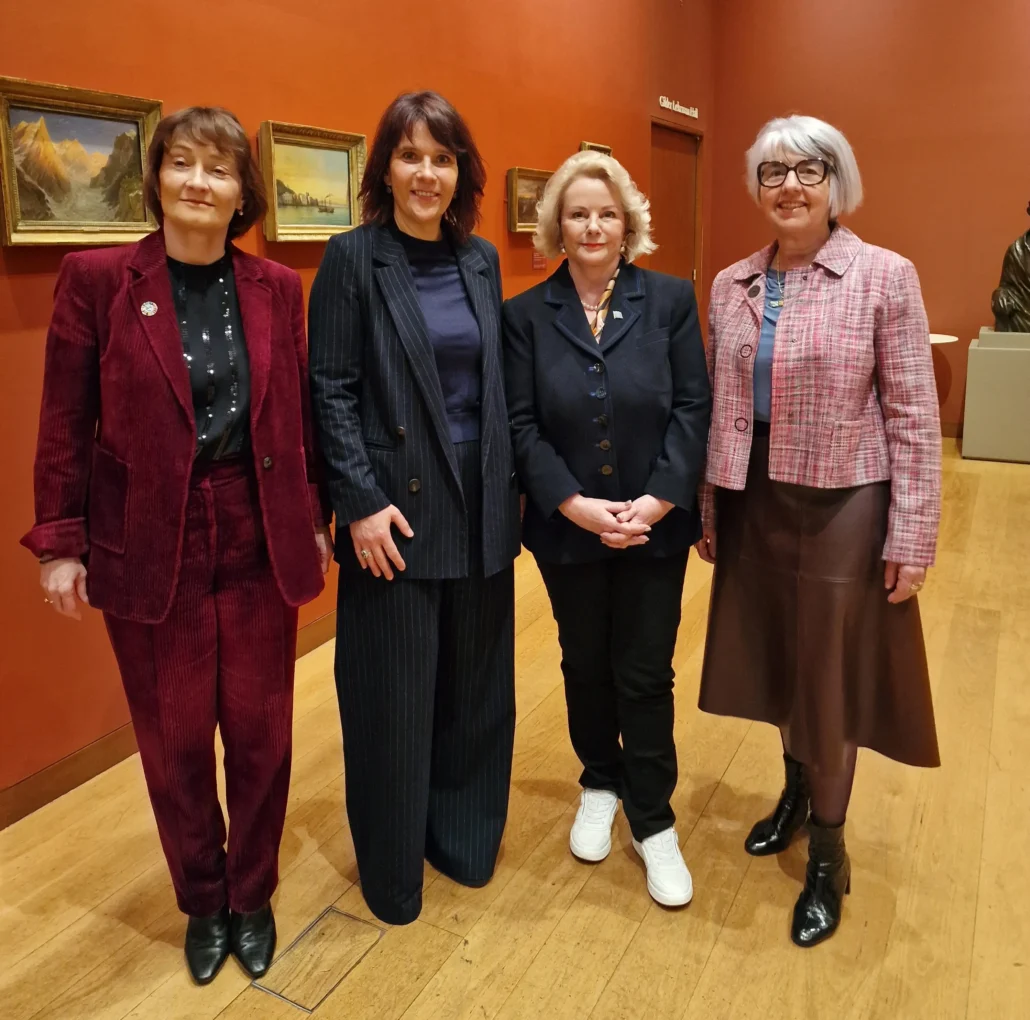
From left to right: Swiss Ambassador Pascale Baeriswyl, Dr. Stéphanie Lachat, Co-Director of the Swiss Federal Office for Gender Equality, our Vice President Dr. Sibylle von Heydebrand and Swiss Federal Councilor Elisabeth Baume-Schneider at the inauguration event at the Morgan Library in New York
Drawing on Afghanistan’s traditional consultative mechanism, the jirga, the initiative reclaims a historically male-dominated forum and repositions it as a women-led platform for political agency and collective strategy. As peacebuilder and scholar Palwasha Kakar emphasized, “Sustainable solutions cannot be imposed from outside; they must come from Afghan women themselves.” The Women’s Jirga seeks to translate priorities into policy recommendations and accountability measures for governments, multilateral institutions, and donors.
Speakers also warned that shifting geopolitical priorities and overlapping crises risk pushing Afghan women’s rights further to the margins. Steering Committee member Nadima Sahar noted: “Today, Afghanistan is the only country in the world where girls are banned from both secondary school and university.” Through regional consultations and a global convening later in 2026, the initiative aims to strengthen solidarity and articulate collective demands.
For international women’s organizations such as IAW, the Women’s Jirga illustrates how culturally grounded leadership can sustain women’s agency under repression. The launch made one point unmistakably clear: Afghan women are not only defending their rights — they are shaping the terms of future leadership.
The event was hosted by the Permanent Representatives of Albania, Cabo Verde, the Kyrgyz Republic, Switzerland, and Uruguay on behalf of the Circle of Women Ambassadors, in collaboration with the President of the United Nations General Assembly, H.E. Annalena Baerbock, and in the presence of Swiss Federal Councilor Elisabeth Baume-Schneider, H.E. Ambassador Pascale Baeriswyl, and Dr. Stéphanie Lachat, Co-Director of the Swiss Federal Office for Gender Equality.
Dr. Sibylle von Heydebrand, Executive Vice President of IAW
Arlesheim, Switzerland


3 responses
A strong and well-intentioned initiative — but the opening claim deserves scrutiny. The initiative was launched in New York, on the margins of CSW — by diaspora figures, not from within Afghanistan. Women still living under Taliban rule are largely forced to act in the shadows, under surveillance, with shrinking resources. This raises an uncomfortable question: how connected is this initiative genuinely to the women it claims to represent?
The key question remains how this can be realistically implemented, especially given existing structural and political constraints. The current Afghan government is unlikely to change its mind on its own. External intervention — like the Soviet Union’s ten-year war to prevent Afghanistan from falling out of its sphere of influence, which ironically it did: by resisting Soviet communism, Afghanistan moved toward becoming the Islamic state it is today — offers little, and certainly not lasting, success. Only when internal frustration and anger reach a point where risking one’s life seems the only option, is there a chance for change. External support is welcome — but it should be wary of claiming to know better what is right for Afghanistan. Imposed solutions rarely guarantee success.
Thank you for your comment. The article does not suggest that solutions can or should be imposed from outside Afghanistan. On the contrary, one of the central ideas behind the Women’s Jirga is precisely to create space for Afghan women themselves — including those inside the country and in the diaspora — to articulate priorities and shape discussions affecting their future.
Given the realities under Taliban rule, many forms of leadership and participation necessarily take place under extremely difficult conditions. The initiative seeks to support, amplify, and connect these voices internationally, not to speak over them.
That is precisely the question: not what the initiative intends, but how women inside Afghanistan, under surveillance and with shrinking resources, can meaningfully participate in shaping it. Intent and reach are not the same thing.