15 Years of the Istanbul Convention: What Has Changed — and What Hasn't
15 years ago today — May 11, 2011 — the Istanbul Convention opened for signature.
Here’s what has happened since. And why it matters more than ever.
The Istanbul Convention remains the first and only legally binding European treaty dedicated solely to combating gender-based violence. Its framework spans everything from prevention to support services and access to justice.
The key milestones:
-
2014: The Convention entered into force on 1 August 2014, following its 10th ratification. From that point, all ratifying governments became legally bound by its obligations.
-
2020: Poland signalled its exit from the Convention, though no formal steps have followed.
-
2021: Turkey — the very country that hosted the signing and was the first to ratify — became the first state to officially withdraw from the Convention. The Council of Europe described the move as a “devastating” setback for women’s protection.
-
2023: The European Union acceded to the Convention in June 2023, bringing it into force for the EU on 1 October 2023.
-
2025: Latvia’s attempt to withdraw from the Istanbul Convention was temporarily halted after President Rinkēvičs vetoed the parliamentary vote to leave the treaty. Following public protests and political divisions within the government, lawmakers postponed any final decision until after the 2026 elections, meaning Latvia remains a member of the Convention for now.
-
April 2026: The Parliamentary Assembly of the Council of Europe adopted a new resolution calling for renewed political will and adequate resources to counter growing attacks on the Convention — nearly 12 years after it entered into force.
Today, several EU member states — Lithuania, Czech Republic, Slovakia, Hungary, and Bulgaria — still refuse to ratify, often citing the Convention’s use of the term “gender” as ideologically loaded. The influence of anti-gender disinformation, frequently amplified by actors outside Europe, has played a significant role in fuelling this resistance.
The numbers are sobering: Around 2,871 women were killed in femicides in Europe in 2024 (minimum estimate across 35 countries), with wide underreporting and major differences between countries. Roughly one in five women in Europe experience intimate partner violence during their lifetime, though the real number is likely higher due to underreporting.
Civil society alliances warn that anti-feminism, right-wing populism, and cuts to social services are actively endangering protection for survivors of violence. Rising military budgets are undermining the Istanbul Convention by draining the essential funding needed to turn its legal protections into reality.
The bottom line:
15 years in, the Istanbul Convention has changed laws, shaped policies, and saved lives across Europe.
But it was never meant to be self-executing. The Assembly’s 2026 resolution is a clear signal: demonstrated positive impact on the ground is not enough — renewed political will and sustained resources are urgently needed.
The convention exists. The numbers demand more than existence.
Sanja Jeraj
Head of Delegation to the Council of Europe and
Interest Group Representative to the European Parliament.
Sources
The Convention
- Istanbul Convention — full text (Council of Europe)
- Key facts (Council of Europe)
Turkey’s withdrawal
- Turkish Official Gazette, March 2021
- Council of Europe Secretary General’s response
- Istanbul Convention framework in crisis (German Marshall Fund)
EU accession
- EU accession to the Istanbul Convention (European Parliament)
- European Women’s Lobby
- Convention enters into force for the EU (Council of Europe)
Latvia
- Latvia’s governing coalition dispute over Istanbul Convention (OSW)
- Latvia postpones withdrawal vote
- Analysis: Latvia and the Istanbul Convention (Stockholm School of Economics)
PACE 2026 resolution
Statistics
- Femicide in Europe 2024 (WAVE Network)
- Femicide rates by country (Euronews)
- EU gender-based violence survey (FRA)
Civil society and funding
- 2025 State of Civil Society Report — gender rights (CIVICUS)
- Military spending and gender equality funding (WAVE Network)
Impact
- How the Istanbul Convention is saving lives (Council of Europe)
- 15 years: renewing our commitment (OHCHR)
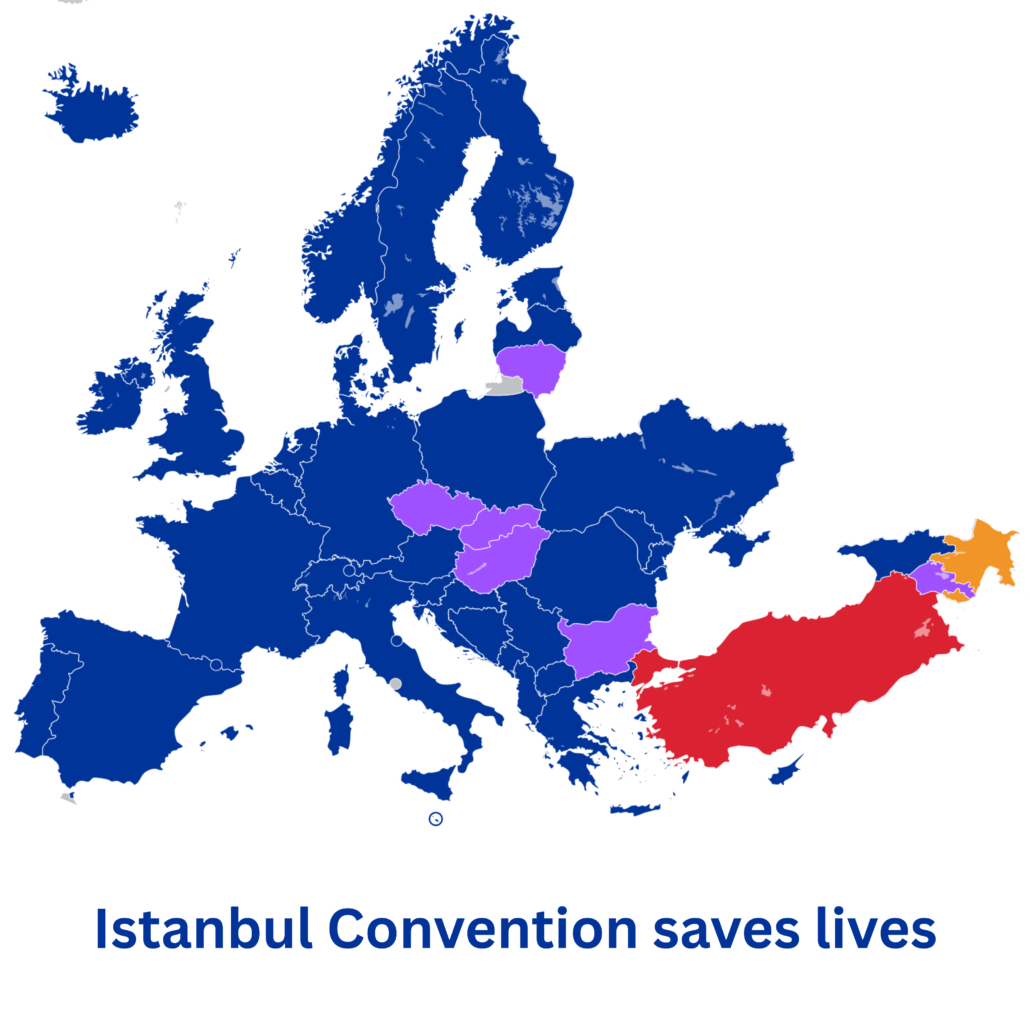
Map of Istanbul Convention ratification status as of May 2026.
Source: https://en.wikipedia.org/wiki/Istanbul_Convention