
International Alliance of Women
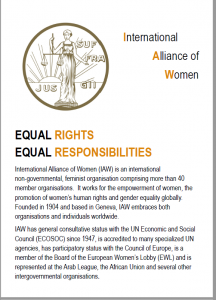
International Alliance of Women (IAW) is a global NGO with members in Africa, Asia, Europe, North America, and Oceania, working to advance women’s human rights, equality, and empowerment.
Its members are mainly national NGOs, though individual membership is also welcome.
IAW has held consultative status with the UN’s ECOSOC since 1947 and is one of only around 130 NGOs with general consultative status (of roughly 15,000 registered NGOs, about 6,500 hold consultative status).
IAW is accredited to multiple UN agencies, has participatory status with the Council of Europe, and has a monitoring status at the Arab League, African Union, and other international organisations.
History
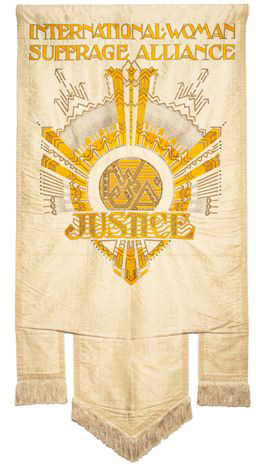
In 1902, the International Alliance of Women for Suffrage and Legal Citizenship was founded by leading American suffragists at a meeting in Washington attended by women from eleven countries. A second meeting in Berlin in 1904 formally constituted the organisation under the name International Woman Suffrage Alliance (IWSA), which became the preeminent international women’s suffrage organisation. The IWSA temporarily ceased operations during the First World War.
At the Congress of 1926 in Paris, the name was changed to International Alliance of Women for Suffrage and Equal Citizenship, and a strong link with the League of Nations was established.
In 1946, the present name, International Alliance of Women (IAW), was adopted, with the subtitle Equal Rights – Equal Responsibilities. Since 1947, IAW has held general consultative status with the United Nations Economic and Social Council (ECOSOC), being one of the first organisations to receive this status.
Colour
colours were important in the iconography of the suffrage movement. The use of gold began with Elizabeth Cady Stanton and Susan B. Anthony’s campaign in Kansas in 1867 and derived from the sunflower, the Kansas state symbol. Suffragists used gold pins, ribbons, sashes, and yellow roses to symbolise their cause. In 1876, during the US Centennial, women wore yellow ribbons and sang the song “The Yellow Ribbon”. In 1916, suffragists staged “The Golden Lane” at the national Democratic Convention: all delegates had to walk through a line of women stretching several blocks, dressed in white with gold sashes, carrying yellow umbrellas and draped with hundreds of yards of gold bunting. Gold also signified enlightenment, the professed goal of the mainstream US suffrage movement.
Read more:
- Our former website can be viewed here.
- “The International Woman Suffrage News” Centenary Edition 1904-2004 (webversion in English)

Contact IAW:
81 Avenue Louis Casaï,
1216 Cointrin, Switzerland