A Visit to the Archives of the Swiss Feminist Movement in Worblaufen
A search for missing issues of our journal — the International Womens’ News (IWN) — had unexpected consequences: the email exchange that followed allowed IAW’s archivist to discover the existence of an important collection of documents on the history of Swiss women, including interesting papers on the history of the IAW.
The missing issues of the IWN were quickly found in my own files, and an already-planned trip to Geneva, Berne, Estavayer-le-Lac and Lausanne allowed for a personal visit to the Gosteli Archive in Altikofen and an encounter with the legacy of Marthe Gosteli.
“Farmer’s daughter, women’s rights activist, educator, politician, candidate for the National Council, internationalist”: Marthe Gosteli engaged at decisive moments in the struggle for Swiss women’s political rights and created, “in her ancestral home in Altikofen, near Berne, through her dedication, her money and her perseverance”, an archive that allowed her to “save Swiss women’s history” (Franziska Rogger: Marthe Gosteli, Stämpfli, 2017). A history of humiliations and disappointments, but also of remarkable community spirit, consistent strategy and unshakeable faith in human rights and women’s rights as an integral part of them — a struggle that finally culminated on 7 February 1971 in the recognition of Swiss women’s right to vote and stand for election.
It was in Altikofen that important decisions in women’s politics were repeatedly prepared. “This was also the case on 2 March 1968, when tactics and the way forward had to be discussed so that Swiss women could prevent the signing of the (European) Convention on Human Rights without women’s rights” (Rogger, p. 125).
Opened in 1982, the archive holds, in addition to organisational records and collections from Swiss women’s organisations, private papers linked to the International Woman Suffrage Alliance (IWSA — the Alliance’s name until the 1926 congress) and the IAW — including those of Emilie Gourd, Irmgard Rimondini-Schnitter, Simone Chapuis-Bischof and Ursula Nakamura-Stoecklin, to name but a few. Reports from four IWSA congresses — Amsterdam 1908, London 1909, Stockholm 1911 and Budapest 1913 — are also preserved here.
Since 1958, the archive has been collecting issues of the IWN, to the completeness of which I have had the privilege of contributing.
As for IAW history, it was Swiss women who, after both World Wars and overcoming wounds and resentments, made reconciliation and renewed cohesion possible by organising the first post-war gatherings: in June 1920 in Geneva, at the 8th IWSA/IAW Congress at the Maison communale de Plainpalais, organised by the Swiss Association for Women’s Rights (adf-svf) and presided over by Emilie Gourd; and in August 1946 in Interlaken, again organised by the adf-svf, this time under Elisabeth Vischer-Alioth.
And so my brief excursion into the rich history of Swiss women, kindly guided by archivist Solange Jaccard, came to an end. The Gosteli Archive team gathered for an internal meeting, and I, enriched by this new experience, began my nostalgic journey towards Estavayer-le-Lac, carrying with me the book on Marthe Gosteli and a few small practical gifts. In 2009, at the IAW International Meeting organised by the adf-svf in Heiden, our Swiss hosts invited us on a “Tour de Switzerland” which made an enchanting stop in Estavayer-le-Lac at the invitation of the Femmes Broyardes, followed the next day by the presentation of Le combat pour les droits égaux, published by the adf-svf, Schwabe Verlag Basel 2009 (Rosy Weiss, Traveling in Politics and Friendship, 2026, p. 68–69).
Rosy Weiss is a former President of the International Alliance of Women.
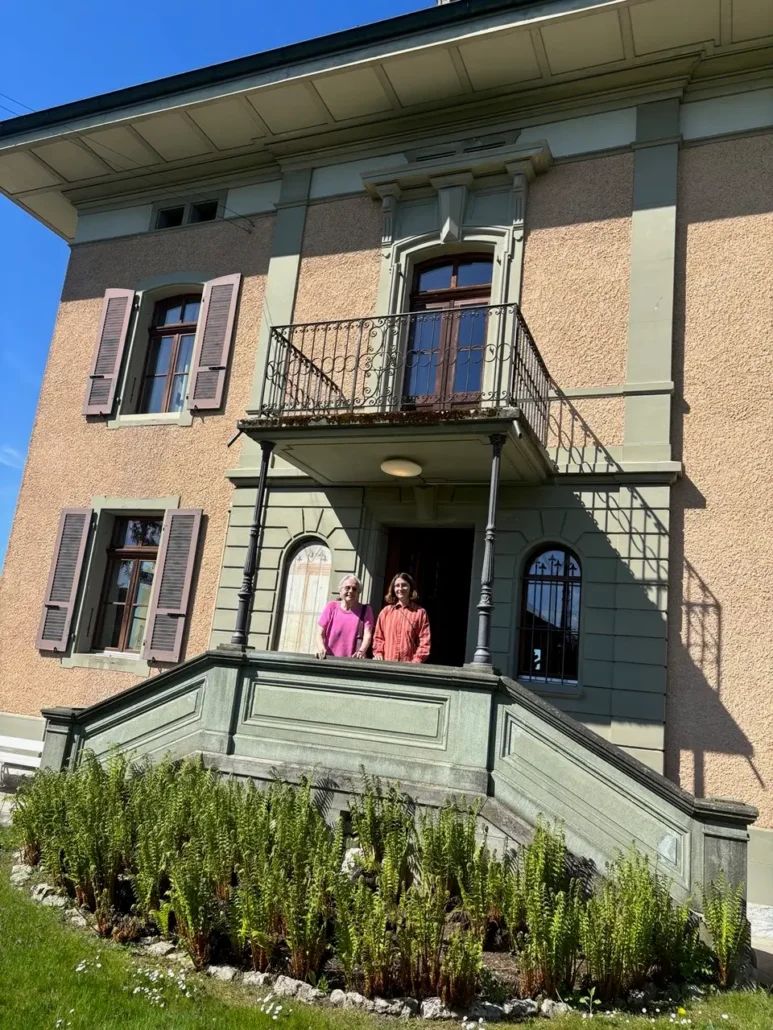
Rosy Weiss at the Gosteli Archive in Altikofen, April 2026

6 responses
Surprised to see both languages on this page.
Indeed. Normally the French version would be in the French section of the website.
French is now where it belongs. Well done!
I agree, Brava!
Sanja, how do I download Rosy’s book? Thanks.
Sanja is no longer working on the website, Anita. Ask Kerstin.